
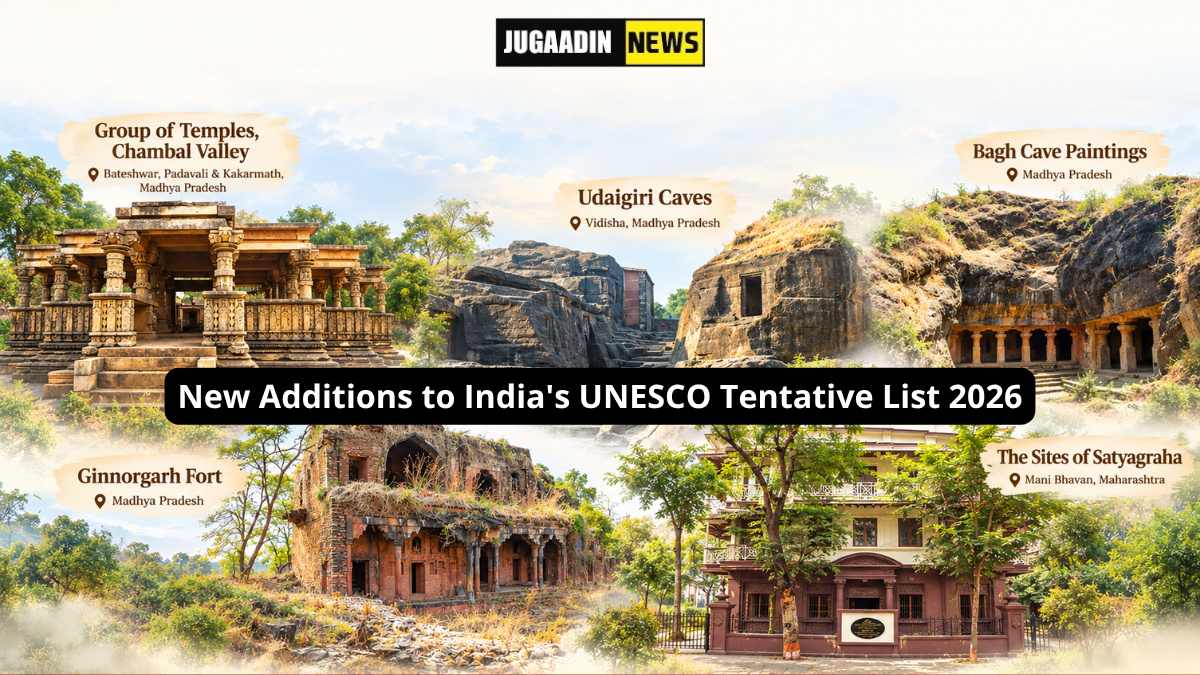
5 new sites have been added to India’s UNESCO Tentative List in 2026, taking the country’s total to 78 sites. The new additions include heritage sites from Madhya Pradesh and a transnational nomination connected to Mahatma Gandhi’s Satyagraha movement.
According to the official UNESCO World Heritage Centre, the five sites have been included based on their historical, cultural and architectural significance.
The Group of Temples of the Chambal Valley includes Bateshwar, Padavali and Kakarmath in Madhya Pradesh. Dating mainly from the 8th to 11th centuries, the temple group represents an important phase in the development of regional Nagara-style architecture.
The Bagh Cave Paintings comprise nine rock-cut Buddhist caves in Madhya Pradesh, mainly dating from the 4th to 6th centuries. Their murals are important examples of post-Ajanta Buddhist cave paintings.
The Udaigiri Caves are a Gupta-era rock-cut sacred complex featuring 20 caves, sculptures and inscriptions. The site includes the famous Varaha relief in Cave 5 and Anantasayana Vishnu in Cave 13.
The Ginnorgarh Fort was an important political and administrative centre of the Gond kingdom from the early 16th to early 18th century. Its remains include palaces, stepwells, reservoirs, wall paintings and an indigenous water-management system.
The Sites of Satyagraha is a transnational nomination covering nine properties across India and South Africa, including Sabarmati Ashram, Mani Bhavan, Sevagram Ashram and Phoenix Settlement. The sites trace the emergence and development of Mahatma Gandhi’s Satyagraha movement.